



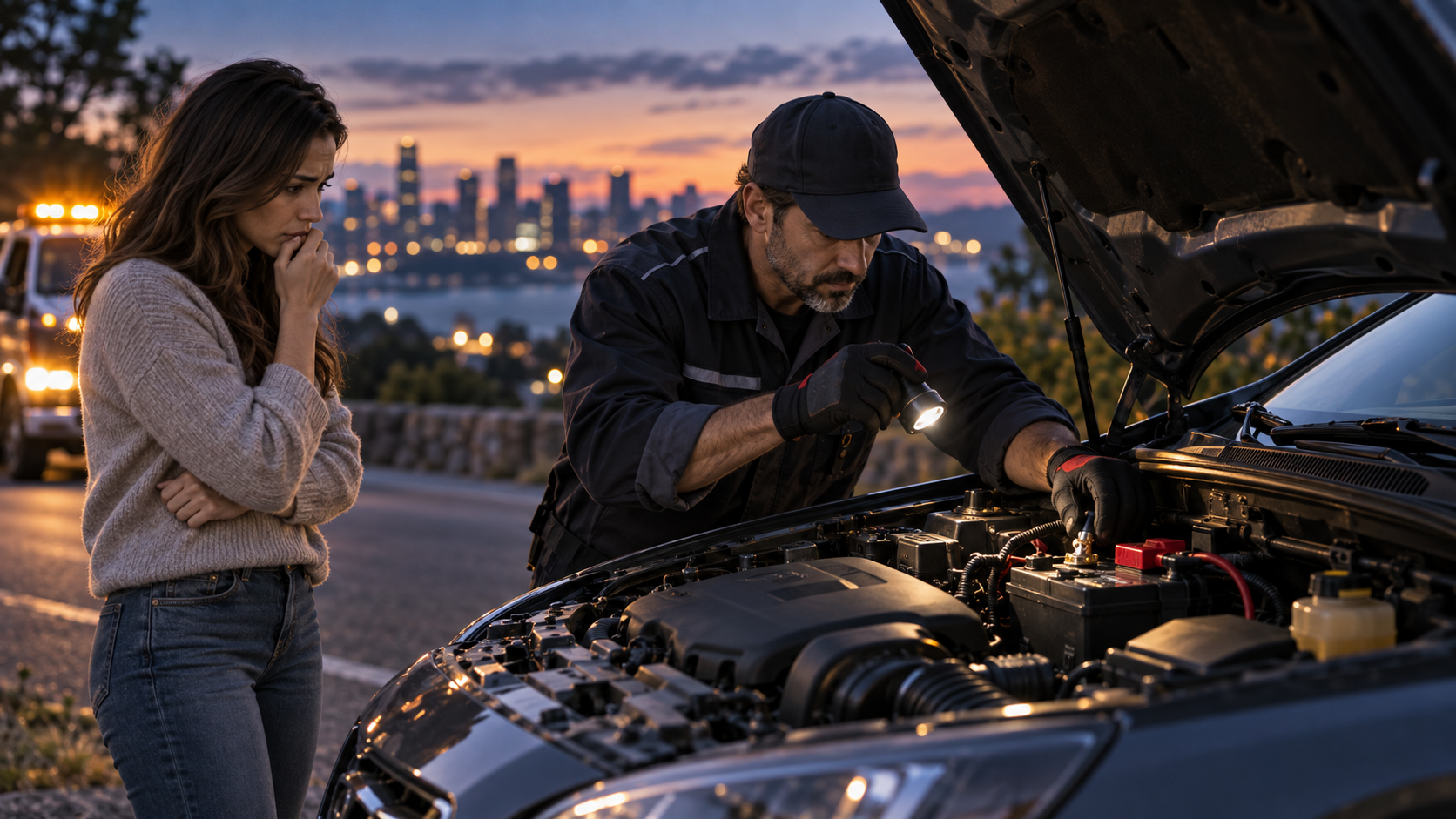
You get into the car, turn the key or press the start button, and instead of the engine coming to life, you hear clicking.
Great. Exactly what you needed before work.
A clicking sound when trying to start car engines is extremely common, and the good news is that it often points to the starting or electrical system rather than some mysterious engine failure.
Still, not every click means the same thing.
Rapid clicking usually tells a different story than one loud click. A car that clicks while the dashboard goes dark needs a slightly different check from one where every light stays bright. And if the starter clicks only on cold mornings, that is useful information too.
The trick is to pay attention to the pattern before replacing anything.
A battery is often blamed first, and sometimes correctly. But loose battery terminals, poor grounds, starter motors, relays, charging-system problems, and other electrical faults can produce very similar symptoms.
So start with the sound itself.
Rapid Clicking vs. One Single Click
This is probably the quickest way to narrow things down.
If the car makes several fast clicks – click-click-click-click – low available battery voltage is one of the most common causes.
If you hear one solid click and nothing else, the starter or starter circuit deserves more attention.
Neither pattern proves a specific part has failed, but it gives you a useful starting point.
| What You Hear | What the Car Does | Common Areas to Check |
|---|---|---|
| Rapid repeated clicking | Engine does not crank | Weak battery, discharged battery, loose battery connection |
| One strong click | No cranking | Starter motor, solenoid, cables, battery connection |
| Soft repeated clicks | Lights may dim | Low battery voltage or high resistance in connections |
| Click followed by slow cranking | Engine turns sluggishly | Weak battery, poor cables, starter problem |
| No click | No crank | Start circuit, battery, relay, gear-position switch, security system |
| Click and all lights go out | Electrical power disappears | Loose or badly corroded main battery connection |
Why a Weak Battery Makes That Rapid Clicking Noise
The starter motor needs a large amount of electrical current.
Your radio does not. Neither do the dashboard lights or cabin lights.
That is why a battery can seem perfectly alive when you first sit in the car and still fail the moment you try to start the engine.
When the starter solenoid activates, it asks the battery for a lot of power. If battery voltage immediately falls too low, the solenoid drops out.
Then the voltage rises slightly.
The solenoid tries again.
Voltage drops again.
And you hear that fast clicking sequence.
This is why rapid clicking is so closely associated with a weak or discharged battery.
But Why Did the Battery Go Flat?
This is the more useful question.
Sometimes the battery is simply old and can no longer hold enough usable charge. But batteries also become discharged for reasons that have nothing to do with the battery itself.
Common possibilities include:
- Lights were left on while the car was parked.
- The vehicle sat unused for an extended period.
- The alternator is not charging correctly.
- There is an electrical draw while the vehicle is switched off.
- A battery cable is loose or corroded.
- The battery has deteriorated with age or temperature exposure.
- The car is driven mainly on very short trips.
- A recently installed battery was not fully charged.
If you jump-start the car and everything seems normal afterward, do not immediately assume the problem is solved.
If the battery goes flat again tomorrow, something caused that discharge.
Can the Lights Work With a Bad Battery?
Yes. Easily.
This causes a lot of confusion.
You turn on the headlights and they look normal. The stereo works. The windows move. So surely the battery must be good, right?
Not necessarily.
The starter motor can demand hundreds of amps for a brief period, depending on vehicle and conditions. Interior electronics need only a fraction of that.
A tired battery may still power low-demand accessories while failing completely under starter load.
Think of it like someone who can carry a grocery bag but cannot lift a refrigerator. There is still strength there – just not enough for the big job.
What Does One Loud Click Mean?
A single click often means the starter solenoid is moving, but the starter motor itself is not turning the engine.
That can happen because the starter is failing.
But do not condemn it yet.
The starter may not be receiving enough current because of a weak battery, damaged cable, loose battery terminal, poor engine ground, or resistance somewhere in the circuit.
In other words, a perfectly good starter can behave badly if the electrical path feeding it is poor.
This is why a proper voltage-drop test can be so useful.
Starter Motor Problems Often Begin Intermittently
A starter does not always fail in one dramatic moment.
Sometimes you turn the key and get one click.
You try again. Click.
Third attempt? The engine suddenly cranks normally.
That can happen when internal starter contacts or motor components are worn.
Heat can also change the symptom. Some failing starters work fine when the engine is cold and refuse to cooperate after the car has been driven and everything under the hood is hot.
Others do exactly the opposite.
If the vehicle has started doing this occasionally, do not wait for the day when “occasionally” becomes “not at all.”
What Exactly Is the Starter Solenoid?
The starter solenoid has two jobs.
It helps move the starter drive into position so it can engage the engine, and it switches the heavy electrical current needed by the starter motor.
That familiar click may actually be the solenoid moving.
So hearing the click tells you that at least part of the starting command is reaching the starter assembly.
It does not tell you whether the starter motor is healthy or whether enough electrical power is reaching it.
Battery Terminals Are Easy to Overlook
Before buying expensive parts, look at the battery connections.
A slightly loose terminal can cause surprisingly dramatic symptoms.
The connection may be good enough for the car’s electronics but not good enough for the massive current required during starting.
Corrosion can create the same problem.
Look for white, blue, or greenish buildup around the battery posts and cable ends.
Also check whether the cable clamp can move by hand. It should normally be secure.
If everything inside the car goes completely dead the moment you attempt to start, then mysteriously comes back after you release the key, a poor main battery connection becomes particularly suspicious.
Ground Connections Matter Too
Electricity has to travel back to the battery.
That means the negative side of the circuit matters just as much as the positive cable.
Cars normally have ground connections between the battery, body, engine, and sometimes transmission.
If a ground strap becomes loose, corroded, damaged, or internally broken, starter performance can suffer.
Symptoms may include slow cranking, a single click, repeated clicks, flickering electronics, or starting problems that seem to come and go.
Ground faults are particularly annoying because the cable may look fine from the outside.
Could the Alternator Cause a Clicking No-Start?
Yes, but usually indirectly.
The battery supplies the energy needed to crank the engine.
Once the engine is running, the alternator supplies electrical power and helps restore energy to the battery.
If the charging system stops working, the battery gradually loses its charge.
You may drive home without realizing anything is seriously wrong. Then the next morning you turn the key and hear rapid clicking.
The immediate symptom comes from a discharged battery.
But replacing the battery alone would not fix the original charging problem.
This is why repeated dead batteries should lead to charging-system testing rather than an endless cycle of jump-starts.
Battery, Starter, or Alternator?
| Possible Cause | Typical Clues | Useful Next Check |
|---|---|---|
| Weak battery | Rapid clicks, slow crank, lights dim strongly | Battery load or conductance test |
| Loose battery terminal | Intermittent power, clicking, electronics cutting out | Inspect and secure terminals |
| Bad ground connection | Slow crank, clicking, strange electrical behavior | Voltage-drop test on ground circuit |
| Failing starter | One click, intermittent no-crank, battery tests good | Test voltage and current at starter |
| Charging-system problem | Battery repeatedly goes flat | Check charging voltage and system operation |
| Starter relay or control fault | Click or no crank despite good battery | Test starter-control circuit |
What If the Dashboard Lights Dim When You Turn the Key?
This is a useful clue.
Some dimming during cranking is normal because the starter is using a lot of current.
But if the lights become extremely dim or disappear completely while the engine does not crank, there may be a major voltage drop.
A weak battery is one possibility.
A poor cable connection is another.
A starter drawing abnormal current can also pull voltage down heavily.
If the lights remain bright while you hear one solid click, the diagnosis may lean more toward the starter or starter circuit, although the battery still needs to be tested rather than assumed good.
Can Cold Weather Cause the Clicking?
Cold weather does not create a healthy starting-system problem out of nowhere, but it can expose one that was already developing.
Battery performance drops in low temperatures.
At the same time, cold engine oil can increase the amount of effort needed to turn the engine.
So the battery has less available power while the starter may need more of it.
That is why a battery that seemed fine in September can suddenly struggle on the first freezing morning.
If you notice clicking only during cold starts, battery condition and connections are worth checking before winter gets colder.
Why Does the Car Click Only When It Is Hot?
A hot-start problem can push attention toward the starter or electrical resistance in the starting circuit.
Under-hood temperatures rise after driving. Heat can change electrical resistance and reveal wear inside a marginal starter.
You may drive to the grocery store, shut the engine off, come back ten minutes later, and hear one click.
Then after the car cools down, it starts again.
That pattern is worth mentioning to a technician because intermittent faults are much easier to diagnose when the operating conditions are known.
Can a Starter Relay Cause Clicking?
It can.
The starter relay is part of the control side of the starting circuit on many vehicles.
When you request a start, the relay helps send the command to the starter solenoid.
A relay can click even when its internal contacts are not transferring current properly.
But hearing the relay click does not prove the relay is bad.
Testing whether the correct voltage enters and leaves the relay is far more useful than replacing it because it made a sound.
What About the Park or Neutral Switch?
Automatic vehicles generally allow starter operation only when the transmission is in Park or Neutral.
If the vehicle does not correctly recognize Park, it may refuse to crank.
One simple clue is whether starting behavior changes when you move the selector to Neutral.
If the car suddenly starts in Neutral but repeatedly refuses in Park, that information can point toward the transmission-range or neutral-safety circuit.
Do not treat this as a final diagnosis, though. Modern systems can involve sensors, wiring, modules, and software logic.
Push-Button Start Cars Can Click Too
A start button does not eliminate the traditional 12-volt starting system.
Most gasoline-powered vehicles still need a starter motor and a healthy low-voltage electrical system.
Push-button start simply changes how the driver’s request enters the system.
The car may need to recognize the key, detect the brake pedal, confirm the transmission is in Park, and communicate between several modules before allowing starter operation.
And yes, a weak 12-volt battery can make a modern car behave very strangely.
You may see warning messages, flickering displays, clicking relays, or systems rebooting.
Modern electronics do not particularly enjoy low voltage.
Could It Be the Key Fob Battery?
A weak key-fob battery can cause problems with key recognition on some vehicles.
But it normally does not create the classic rapid clicking caused by the vehicle’s main battery losing voltage under starter load.
If the dashboard reports that the key is not detected, try the manufacturer’s backup starting procedure.
Many vehicles have a specific place to hold the key fob when its internal battery is weak.
If the starter is actively clicking and the dashboard dims, focus more on the vehicle’s 12-volt electrical system.
Can an Immobilizer Stop the Car From Starting?
Yes.
Modern security systems can prevent engine starting when the vehicle does not recognize an authorized key.
Different cars react differently.
Some crank but will not actually start. Others may prevent cranking.
If a key-shaped warning, security indicator, or immobilizer message appears at the same time, that deserves attention.
Still, classic repeated clicking with heavy dimming usually points more strongly toward voltage or starting-circuit trouble.
Can You Jump-Start a Car That Is Clicking?
If low battery power is the problem, a proper jump-start may get the engine running.
Follow the vehicle manufacturer’s procedure because battery locations and designated jump points differ.
Do not assume every battery is sitting under the hood in the same familiar corner.
Some vehicles have the battery in the trunk, under a seat, or hidden behind trim but provide dedicated jump terminals in the engine compartment.
And if you are dealing with a hybrid, follow the vehicle-specific instructions carefully.
If the battery case is swollen, leaking, frozen, cracked, or visibly damaged, do not attempt an ordinary jump-start.
If the Jump Works, Is the Battery Definitely Bad?
No.
This is an important distinction.
If extra electrical power makes the car crank normally, you have learned that available starting power was part of the problem.
You have not yet learned why.
The battery may simply have been discharged.
The alternator might not be charging it.
An electrical device may be draining power overnight.
Or a poor connection may have been temporarily improved when jumper clamps were attached.
Test before buying.
Why Does the Car Start After Five or Six Attempts?
Intermittent problems are common in starting systems.
A worn starter may fail to make proper electrical contact on one attempt and work perfectly on the next.
A loose terminal can behave similarly.
So can certain relay or control-circuit faults.
If the car starts after repeated key turns, it may feel tempting to call the issue solved.
It is not.
All you have really learned is that the failure is intermittent.
And intermittent problems have a habit of becoming permanent exactly when you are farthest from home.
What If the Starter Spins but the Engine Does Not Turn?
This sounds different from ordinary clicking.
You may hear a high-speed electric whirring sound while the engine itself does not crank.
That can indicate that the starter motor is spinning but its drive mechanism is not engaging the engine’s flywheel or flexplate correctly.
Possible causes include a starter-drive problem or damaged engagement teeth.
This generally requires mechanical inspection rather than another battery.
Can the Engine Itself Be Seized?
It is possible, although battery and starter problems are far more common.
If the engine cannot physically rotate, the starter may produce a heavy click while attempting to turn it.
This becomes more concerning if the engine stopped suddenly while driving, suffered severe overheating, lost oil pressure, or made loud mechanical noises before the no-start condition appeared.
A technician can check whether the engine can be rotated manually before replacing the starter.
That simple distinction matters.
What Can You Check Yourself?
You do not need to start taking the car apart.
A few basic observations can make diagnosis much easier:
- Listen for one click or many rapid clicks.
- Watch whether dashboard lights stay bright or dim.
- Look for corrosion around battery terminals.
- Check whether battery cables seem obviously loose.
- Try Neutral if an automatic vehicle will not crank in Park.
- Notice any key or security warnings.
- Think about whether the problem is worse when hot or cold.
- Remember whether the battery recently needed a jump.
- Check whether a battery or charging warning appeared while driving.
Stop there if you are not comfortable working around vehicle electrical systems.
There is no prize for turning a simple no-start into a damaged electrical system.
Battery Safety Is Worth Taking Seriously
A car battery may look harmless sitting quietly under the hood, but it can deliver very high current.
A metal tool accidentally bridging the wrong terminals can create an intense short circuit.
Batteries may also release gases, particularly during charging or when something is wrong.
Avoid sparks and open flames around a battery.
Do not attempt to jump a visibly frozen, swollen, cracked, or leaking battery.
And if you are unsure about the correct jump-start procedure, check the owner’s manual rather than improvising.
How a Repair Shop Diagnoses a Clicking No-Start
Good diagnosis usually begins with battery condition.
A technician may measure resting voltage, but voltage alone does not tell the full story. A battery can show decent voltage and still fail when asked to supply starter current.
That is why battery load testing or modern conductance testing can be helpful.
Next come connections.
A voltage-drop test can show whether too much electrical resistance exists across battery cables, terminals, or ground paths while the circuit is under load.
If power supply is good, attention turns to the starter.
The technician can check whether the starter receives the correct voltage during a start request.
If full voltage reaches a starter that refuses to operate, the starter becomes a strong suspect.
If the start signal never reaches it, the diagnostic path moves toward the relay, switches, wiring, transmission-position input, control modules, or security system.
It is a much cleaner process than swapping parts until the engine starts.
Why Replacing Parts Based on the Sound Can Get Expensive
Imagine you hear one click and replace the starter.
The new starter behaves exactly the same way because the real problem is a corroded ground cable.
Now you have bought an unnecessary starter and still have a car that will not start.
The same thing can happen with batteries.
A new battery may temporarily make a poor connection or marginal starter less obvious because it can provide more current.
Then the problem returns.
Electrical diagnosis can look boring compared with installing new parts, but boring is often cheaper.
Signs You Should Stop Trying to Start the Car
Repeated start attempts are not always harmless.
Stop and investigate if you notice:
- Smoke from the battery, starter area, or wiring.
- A strong electrical burning smell.
- Battery cables becoming unusually hot.
- A swollen, cracked, or leaking battery case.
- Loud grinding instead of normal starter operation.
- Recent severe engine overheating or loss of oil pressure.
- A heavy mechanical clunk accompanied by signs the engine may be locked.
- Electrical systems repeatedly shutting down during start attempts.
At that point, repeatedly turning the key is unlikely to improve your morning.
FAQ
Why do I hear rapid clicking when I try to start my car?
Rapid clicking commonly happens when battery voltage drops too low under starter load. A weak or discharged battery, loose battery terminal, corrosion, or poor cable connection can cause it.
What does one click and no start mean?
A single click may mean the starter solenoid is engaging while the starter motor does not turn. The cause could be the starter, battery, cables, ground connection, or another starter-circuit fault.
Can my battery be bad even if the lights work?
Yes. Lights require far less current than the starter motor. A weak battery can run dashboard electronics yet fail when you attempt to crank the engine.
Why does my car click but start after several attempts?
An intermittent starter, worn solenoid contacts, loose electrical connection, or control-circuit fault can behave this way. The temporary recovery does not mean the problem has repaired itself.
Will a jump-start fix a clicking car?
It may start the vehicle if low battery power is involved. But a successful jump does not prove the battery is defective. The battery could be discharged because of a charging-system problem or electrical drain.
Can a bad alternator cause clicking when starting?
Indirectly, yes. If the alternator fails to recharge the battery while driving, the battery may become too weak to operate the starter the next time you try to start the car.
Should I replace the battery or starter first?
Neither should be replaced purely on a guess. Test battery condition, cables, voltage drop, starter power supply, and charging-system operation to identify the actual fault.
Conclusion
A clicking sound when trying to start car engines usually gives you an important clue rather than a complete diagnosis.
The pattern matters.
Rapid clicking often points toward low available battery voltage. One strong click can make the starter, solenoid, battery cables, or ground circuit more suspicious.
If the dashboard goes completely dark during the attempt, pay close attention to the main battery connections.
And if the car starts after four or five attempts, do not assume the problem disappeared.
Intermittent starters and electrical connections often work right up until the moment they don’t.
The battery remains a logical first check because starting an engine demands a large amount of current. But remember: a discharged battery and a failed battery are not the same thing.
If the alternator is not charging, the healthiest new battery in the store will eventually become discharged too.
The same logic applies to loose or corroded terminals.
A battery can be fully charged and still fail to operate the starter properly if the electrical connection between the two is poor.
So look at the whole starting circuit.
Battery. Connections. Grounds. Starter. Starter-control circuit. Charging system.
Those pieces work together, and one weak link can leave you listening to clicks instead of an engine.
If the problem appears only when the engine is hot, only on freezing mornings, only in Park, or only after the car has been sitting overnight, remember that detail.
Patterns make intermittent problems much easier to find.
And if a jump-start gets the car running, do not simply toss the jumper cables back into the trunk and forget about it.
Ask why the battery became too weak to start the engine.
Maybe you left a light on. Fine. That has a simple explanation.
But if it happens again, the vehicle is telling you something else is going on.
One final point: avoid replacing a starter just because you hear one click or buying a battery solely because you hear several.
Those clues are useful, but proper testing gives you the answer.
A few voltage measurements can often separate a weak battery from a damaged cable or bad starter without turning the repair into an expensive guessing game.
And if you see smoke, smell burning wiring, notice a damaged battery, or find cables getting unusually hot, stop repeatedly attempting to start the vehicle.
That is the point where professional inspection makes far more sense than another twist of the key.
Most clicking no-start situations are fixable.
The important part is figuring out which piece of the starting system stopped doing its job before replacing the wrong one.


Leave a Reply