


Checking engine oil sounds like one of those basic car tasks everybody is somehow expected to know. Then you open the hood, stare at a maze of plastic covers, caps, hoses, and wires, and realize nobody actually showed you what to do.
The good news is that checking oil is usually simple once you know the routine.
The slightly annoying part? Not every vehicle uses the same routine anymore. Many cars still have a traditional dipstick. Some newer models check oil electronically through the dashboard or infotainment system. A few require the engine to be warm, while others specify a particular waiting period after shutting it off.
So there is one rule that beats every internet shortcut: if your owner’s manual gives a specific procedure, follow that procedure.
Still, the basic idea is the same. You want to know whether the engine has enough oil, whether the level is too high, and whether anything looks obviously wrong before a small problem becomes an expensive one.
Why Engine Oil Level Matters So Much
Engine oil does several jobs at once.
It creates a lubricating film between moving metal parts, helps carry heat away from internal components, holds contaminants in suspension until they reach the filter, and helps protect surfaces from wear and corrosion.
An engine contains parts moving thousands of times every minute. Without enough lubrication, friction and heat rise quickly.
Too little oil can leave parts inadequately lubricated. Too much oil is not ideal either. An overfilled crankcase can allow rotating components to whip the oil into foam, and excessive oil can create other operating problems depending on engine design.
That is why the goal is not “as much oil as possible.”
The goal is the correct level.
Before You Open the Hood
Start by parking the vehicle on level ground.
This matters more than it sounds. If the car is parked nose-up on a steep driveway, oil inside the engine’s oil pan can shift enough to distort the dipstick reading.
Next, check what your owner’s manual says about engine temperature.
For many vehicles, a practical method is to check after the engine has been shut off for several minutes, allowing oil that was circulating through the engine to drain back into the oil pan.
But manufacturers do not all specify the same procedure.
Some recommend checking a warm engine after a defined waiting period. Others allow checking before the engine is started. Electronic oil-measurement systems may have their own conditions, such as a warmed-up engine, level surface, and engine running or recently switched off.
That little difference can affect the reading, so the manual wins.
What You Need
You do not need a garage full of tools.
- A clean paper towel, shop towel, or lint-free rag.
- Your vehicle owner’s manual if the procedure is unfamiliar.
- Gloves if you prefer keeping oil off your hands.
- The correct engine oil if you expect to add any.
- A small funnel can make topping up much cleaner.
That is basically it.
Checking oil is more inspection than repair.
How to Check Oil Level With a Dipstick
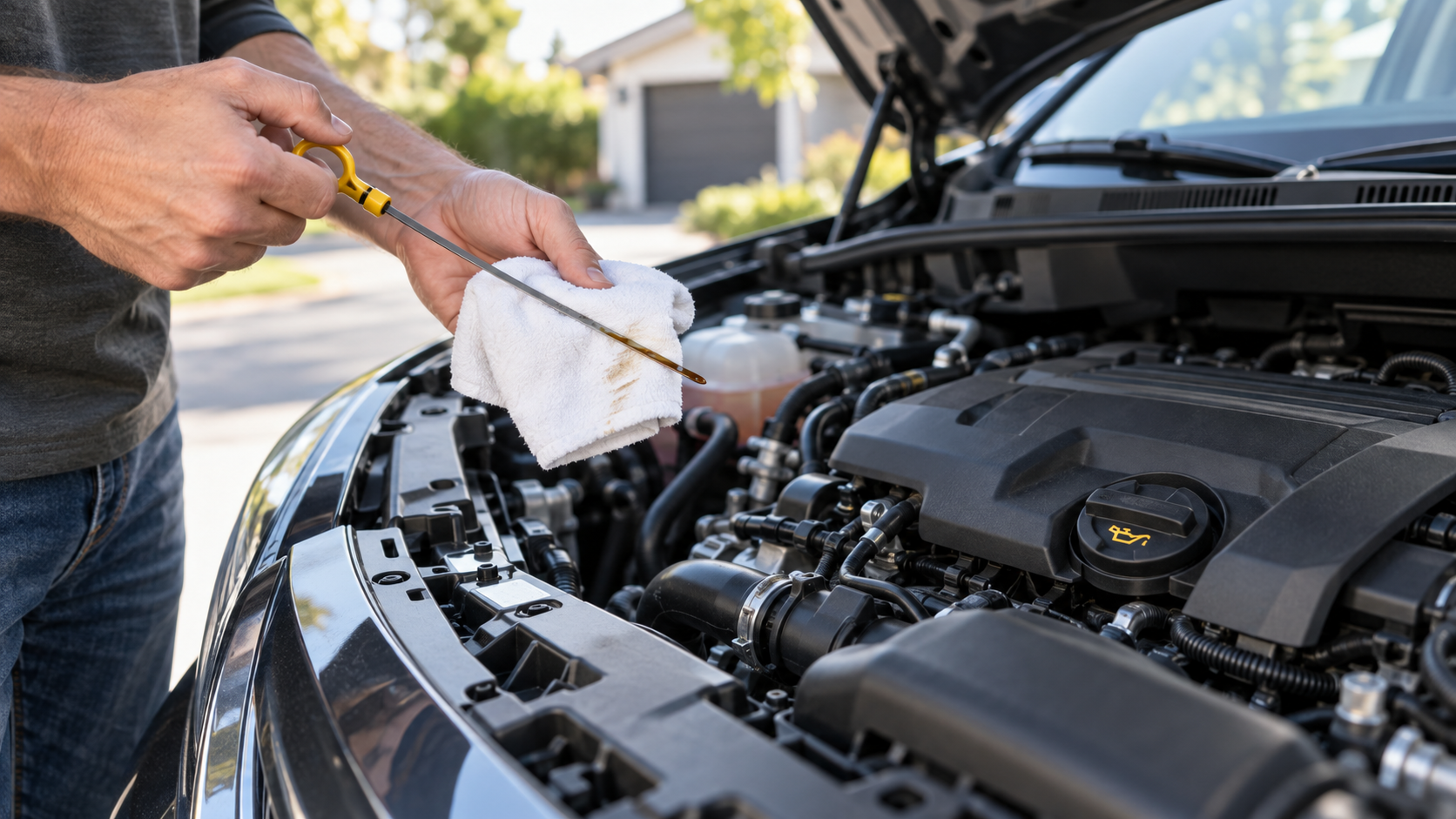
If your car has a traditional engine-oil dipstick, open the hood and locate it.
The handle is often brightly colored – yellow or orange is common – but not every manufacturer follows the same color scheme.
Do not confuse the engine-oil dipstick with a transmission-fluid dipstick on older vehicles. If you are unsure, check the manual before pulling things apart.
1. Park on Level Ground
A flat surface gives you a more reliable reading.
If you have just driven the vehicle, shut the engine off and wait for the period recommended by the manufacturer.
Also remember that under-hood components may be hot after driving.
2. Pull Out the Dipstick
Remove the dipstick completely.
The first reading is usually not the one you want because oil can splash higher on the stick while the engine is running.
Wipe the dipstick clean from the handle toward the tip.
3. Reinsert It Fully
Slide the dipstick all the way back into its tube.
Make sure it is fully seated.
If it stops halfway, do not force it aggressively. Pull it out, align it again, and try gently.
4. Pull It Out Again
Now remove the dipstick and hold it roughly horizontal.
Look at the oil line near the bottom.
Depending on the vehicle, the acceptable range may be marked with two dots, small holes, crosshatching, MIN and MAX labels, L and F markings, or a textured area.
The oil level should normally sit within that marked range.
If it is close to the upper mark without exceeding it, that is generally fine.
If the oil is below the lower mark, more oil is needed.
What the Marks on a Dipstick Mean
| Dipstick Reading | What It Means | What to Do |
|---|---|---|
| Between MIN and MAX | Oil level is within the normal measuring range | No oil may be needed |
| Near MAX | Oil level is close to full | Usually leave it alone |
| At or below MIN | Oil level is low | Add the correct oil carefully |
| No oil visible on dipstick | Level may be seriously low or reading procedure may be wrong | Recheck correctly before driving farther |
| Above MAX | Engine may be overfilled | Do not keep adding oil; investigate |
| Reading differs greatly each time | Vehicle may not be level or oil has not settled consistently | Repeat under correct conditions |
The distance between the lower and upper marks often represents roughly one quart on many vehicles sold in the U.S., but that is not universal.
Do not assume one quart applies to your engine unless the owner’s information confirms it.
How Much Oil Should You Add?
This is where people often turn a simple check into a messy problem.
If the oil is a little low, do not immediately dump an entire bottle into the engine.
Add a small amount.
Then wait briefly for it to reach the oil pan and recheck the dipstick using the same procedure.
Repeat if necessary.
This takes longer than pouring in a full quart, but it is much easier than dealing with an overfilled engine.
You should also make sure the oil matches the viscosity and specification required by the vehicle manufacturer.
You’ll commonly see labels such as 0W-20, 5W-20, 5W-30, or other viscosity grades on oil containers, but the right grade varies by engine.
Many modern vehicles also specify performance standards such as API or ILSAC classifications, and some manufacturers require their own oil approvals.
Use what your owner’s manual specifies.
Where Do You Add Engine Oil?
The oil-filler cap is normally located on top of the engine or valve cover.
It often carries an oil-can symbol and may show the recommended viscosity.
Remove the cap only when you are sure you have identified the correct opening.
This sounds obvious until somebody accidentally pours engine oil into the coolant reservoir.
A funnel helps prevent oil from running over the engine.
Add a little, replace the cap loosely if needed while waiting, then check the dipstick again.
When finished, make sure the filler cap is properly installed.
Do Not Overfill the Engine
More oil does not mean more protection.
If the level is clearly above the maximum mark, continuing to add oil is obviously the wrong move.
Significant overfilling can allow the crankshaft or other rotating parts to aerate the oil. Foamy oil does not lubricate the same way as properly circulating liquid oil.
Depending on the engine, excessive oil can also contribute to increased crankcase pressure, oil entering systems where it should not, smoke, leaks, or drivability problems.
If you accidentally added too much, removing the excess is better than hoping the engine sorts it out.
What Should Engine Oil Look Like?
This is where internet advice gets weirdly dramatic.
Fresh engine oil often looks amber or golden. After some driving, it may become brown or even quite dark.
Dark oil does not automatically mean the oil is bad.
Engine oil collects contaminants and combustion byproducts while doing its job, so color changes naturally.
Appearance alone cannot reliably tell you whether the oil has reached the end of its service life.
The maintenance interval, vehicle’s oil-life monitor, driving conditions, oil specification, and manufacturer’s instructions matter more.
Still, some appearances deserve attention.
Oil Appearance: What May Be Normal and What Is Not
| What You See | Possible Meaning | What to Consider |
|---|---|---|
| Clear amber oil | Often relatively fresh oil | Usually normal |
| Brown or dark oil | Normal oil darkening may have occurred | Check service interval rather than color alone |
| Very low level | Oil consumption, leak, or missed maintenance | Top up correctly and investigate repeated loss |
| Milky or creamy appearance | Possible moisture or coolant contamination | Further inspection may be needed |
| Metallic particles | Possible internal wear | Professional diagnosis is sensible |
| Strong gasoline smell | Possible fuel dilution | Have the cause checked if pronounced |
A little beige residue under the oil cap can sometimes result from moisture condensation, particularly on vehicles used mostly for short trips in cold weather.
That alone does not prove the engine has a blown head gasket.
But milky contamination throughout the oil, unexplained coolant loss, overheating, or other related symptoms deserve a proper diagnosis.
What if Your Car Has No Dipstick?
Welcome to modern car ownership.
Some vehicles use an electronic oil-level sensor instead of a conventional dipstick.
The reading may appear in the gauge cluster, vehicle information menu, or infotainment screen.
The process varies quite a bit by manufacturer.
A vehicle might require the engine to reach operating temperature first. Another may require you to park on a flat surface and switch the engine off for a certain period. Some systems measure while the engine is idling.
So this is not the place to copy a generic YouTube routine from a completely different car.
Follow the vehicle’s own instructions.
Oil Level Is Not the Same as Oil Pressure
This distinction is important.
Oil level tells you how much oil is in the engine’s reservoir.
Oil pressure describes whether the lubrication system is circulating oil at adequate pressure while the engine is operating.
A vehicle can theoretically have enough oil in the pan and still develop an oil-pressure problem due to a pump fault, blockage, internal engine wear, sensor issue, or another failure.
So if a red oil-pressure warning appears while the engine is running, do not treat it like a casual reminder to add a splash of oil at the next gas station.
Safely stopping the engine and checking the situation is more appropriate.
How Often Should You Check the Oil?
There is no single perfect schedule for every driver.
Some modern engines rarely need oil added between services. Others consume a measurable amount normally, especially with age or under demanding driving conditions.
Checking periodically is still a useful habit.
It is especially smart before a road trip, after buying a used vehicle, when you notice a leak, or when the engine seems to be consuming oil.
You may want to check more frequently if:
- The vehicle has high mileage.
- You already know the engine consumes oil.
- You frequently drive long highway distances.
- You tow or operate the vehicle under heavy load.
- You see oil spots where the car is parked.
- An oil warning or low-level message has appeared.
- You recently had engine work performed.
- You are about to take a long road trip.
Once you know how quickly your particular engine’s level changes, you can settle into a routine that makes sense.
Why Is My Oil Level Going Down?
Engines can lose oil in two broad ways.
It can leak out, or the engine can consume it internally.
External leaks may come from gaskets, seals, oil-pan areas, filters, drain plugs, oil-cooler connections, or other components depending on engine design.
Oil consumption happens when oil enters the combustion process or travels through systems where it is eventually burned.
A small amount of consumption can be considered normal by some manufacturers under certain operating conditions.
But if you are repeatedly adding significant quantities between oil changes, it is worth figuring out where the oil is going.
Do not rely only on whether you see blue smoke from the exhaust. Modern emissions systems can sometimes make oil consumption less visually obvious than people expect.
What if There Is No Oil on the Dipstick?
Do not panic, but do not ignore it either.
First confirm that you followed the measurement procedure correctly.
Make sure the vehicle is level, allow the recommended settling time, wipe the dipstick, reinsert it fully, and check again.
If the dipstick still comes out dry, the oil may be significantly below the normal measuring range.
At that point, blindly driving around is not a smart experiment.
Add the correct oil in controlled amounts and bring the level back into the proper range before running the engine unnecessarily.
If the engine suddenly lost a large amount of oil, look for obvious leaks and consider professional inspection.
Why Does the Dipstick Show Different Levels Each Time?
A slightly different reading is not unusual.
A wildly different one usually means the checking conditions are inconsistent.
Perhaps the vehicle is on a slope. Maybe one reading was taken immediately after shutting the engine down and another after waiting ten minutes.
Oil can also smear along the walls of the dipstick tube and make one side of the stick look higher than the other.
If the reading is unclear, wipe the stick and repeat the measurement.
Look for the lowest clear, consistent oil line rather than one random smear farther up the metal.
Should You Check Oil Hot or Cold?
There is no universal answer for every car.
That’s worth repeating because this question generates a lot of unnecessary debate.
Some manufacturers specify checking the oil warm after shutting the engine off and waiting several minutes.
Other vehicles can be checked cold before the day’s first start.
Electronic measurement systems may have yet another procedure.
The important thing is consistency and following the instructions written for your engine.
Does the Engine Need to Be Running?
For most vehicles with a conventional engine-oil dipstick, you do not check the level with the engine running.
The oil must have an opportunity to drain into the oil pan where the dipstick measures it.
There are exceptions to general automotive rules, though, especially with electronic measuring systems.
Again, check the manual rather than assuming.
What Happens if You Use the Wrong Oil?
Modern engines are designed around particular viscosity ranges and oil-performance requirements.
Using the wrong product can affect lubrication, cold-start performance, fuel economy, variable valve timing systems, emissions equipment, and long-term engine durability depending on how different the oil is from the required specification.
Do not select oil only because the bottle says “full synthetic” or “high mileage.”
Those words do not replace the required viscosity and performance specification.
Check the owner’s manual, oil cap, or manufacturer information.
Why Does My Car Say Low Oil Even After I Added Some?
First determine what warning you actually saw.
A low oil-level message and an oil-pressure warning are not necessarily describing the same condition.
If the vehicle electronically measures oil level, the system may also need certain conditions before it updates the reading.
If the message does not clear after the level has been correctly verified, there could be a sensor problem or another fault.
And if the warning refers to oil pressure, adding oil is not guaranteed to solve it.
That requires more caution.
Common Oil-Checking Mistakes
The job is simple, but a few mistakes show up again and again.
- Checking while parked on a steep slope.
- Reading the dipstick immediately after pulling it out the first time.
- Adding a full quart without knowing how low the level actually is.
- Overfilling above the maximum mark.
- Using oil based only on viscosity without checking required specifications.
- Confusing engine oil with transmission or another fluid.
- Assuming dark oil automatically needs immediate replacement.
- Ignoring repeated oil loss after topping up.
- Treating an oil-pressure warning as simply a low-level reminder.
Most of these mistakes are easy to avoid once you slow down for two minutes.
Checking Oil Before a Road Trip
This is one of the easiest pre-trip checks you can do.
Imagine discovering that your engine has been quietly consuming oil after you are already several hundred miles from home.
Not ideal.
Check the level a day or two before departure rather than five minutes before loading the car.
That gives you time to buy the correct oil or investigate an unexpectedly low reading.
If your vehicle tends to consume oil, carrying a sealed container of the exact oil specification used by the engine can be sensible on a long trip.
What About Hybrid Cars?
Hybrid vehicles with gasoline engines still need engine oil.
The gasoline engine may start and stop automatically, which can make the checking routine feel less obvious than on a conventional car.
Make sure the vehicle is fully switched off according to the manufacturer’s procedure before reaching into the engine compartment.
With a hybrid, silence does not always mean the vehicle is completely powered down.
Follow the vehicle-specific instructions before checking anything under the hood.
Can You Trust the Oil-Life Percentage?
An oil-life monitor and an oil-level measurement answer different questions.
Oil-life systems estimate when the oil should be serviced based on mileage, operating conditions, engine data, or algorithms determined by the manufacturer.
They do not necessarily tell you how much oil is physically inside the engine.
You can have plenty of oil that is due for replacement.
And you can potentially have relatively fresh oil but too little of it because of a leak or consumption.
So “80% oil life remaining” does not automatically mean the oil level is okay.
FAQ
How do I check the oil level in my car?
Park on level ground and follow the manufacturer’s temperature and waiting instructions. For a traditional dipstick, remove it, wipe it clean, reinsert it fully, pull it out again, and read the level between the minimum and maximum marks.
Should the car be running when I check the oil?
Usually not when checking with a conventional dipstick. Most dipstick measurements are taken with the engine switched off. Electronic systems may have different requirements, so check the owner’s manual.
How long should I wait after turning the engine off?
The recommended waiting period varies by vehicle. Several minutes is common, but some manufacturers specify a particular procedure. Follow the instructions for your exact car.
What happens if the oil is below the minimum mark?
The engine needs additional oil. Add the correct type in small amounts and recheck the level. If the level keeps dropping, look for leaks or excessive oil consumption.
Is dark engine oil bad?
Not automatically. Oil naturally becomes darker as it operates and collects contaminants. Color alone is not a reliable way to decide whether an oil change is due.
Can too much engine oil damage a car?
Significant overfilling can cause problems, including oil aeration and other lubrication or crankcase issues. Keep the level within the manufacturer’s specified range.
What if my car has no oil dipstick?
Some newer cars use an electronic oil-level sensor. The level may be displayed through the dashboard or infotainment system. Follow the manufacturer’s measurement procedure because operating conditions vary by model.
Conclusion
Learning how to check oil level in car engines is one of those tiny skills that can save you from a very expensive surprise.
And it takes only a few minutes.
The basic routine is simple: park on level ground, follow the manufacturer’s temperature instructions, let the oil settle if required, wipe the dipstick, reinsert it fully, and then read the actual level.
You want the oil somewhere inside the marked operating range.
Not below it. Not dramatically above it.
If the oil is low, add the correct product gradually rather than pouring in a whole bottle and hoping for the best.
Check again after each small addition.
That little bit of patience matters because removing excess oil is far more annoying than adding another few ounces.
Also remember that the appearance of the oil does not tell the entire story.
Dark oil is not automatically ruined oil. Fresh-looking oil is not proof that the level is correct. And an oil-life monitor does not necessarily tell you how much oil is physically inside the engine.
These are separate questions.
What matters most is having the right amount of the correct oil and servicing it according to the requirements for your vehicle.
Pay attention when the level repeatedly drops too.
Adding oil once because it is slightly low is one thing. Adding a quart every few weeks is a pattern.
The oil has gone somewhere.
Maybe there is an external leak. Maybe the engine is consuming it. Maybe a recent service left the level incorrect.
Whatever the reason, topping it up forever without asking why is not much of a maintenance strategy.
And if the dipstick comes out completely dry, treat that differently from a level that is barely below MIN.
Recheck correctly first. If it is still dry, bring the level back into range before unnecessary driving and investigate why it became so low.
The same goes for obvious overfilling.
Do not assume extra oil gives extra protection.
Engines are designed to operate within a particular oil-level range, and there is a reason the dipstick has a maximum mark.
One more distinction is worth keeping in your head: oil level and oil pressure are not the same thing.
If you see a red oil-pressure warning while driving, simply checking the dipstick and continuing on your way may not be enough. A lubrication-system problem can exist even with oil showing on the stick.
That warning deserves immediate attention.
If your vehicle does not have a dipstick, the same basic idea still applies. You are just getting the measurement electronically.
Use the dashboard or infotainment procedure specified for your model rather than copying a routine from another car.
And with hybrids or vehicles that can restart their engines automatically, make sure the vehicle is genuinely switched off before reaching into the engine compartment.
Checking oil is not glamorous car maintenance.
There is no dramatic tool chest. No lift. No complicated scanner.
Just a rag, a few minutes, and one simple question: does the engine have the amount of oil it is supposed to have?
That question is worth answering regularly.
Because discovering low oil on a dipstick in your driveway is boring.
Discovering it after the engine starts making noise on the interstate is a very different kind of day.


Leave a Reply