



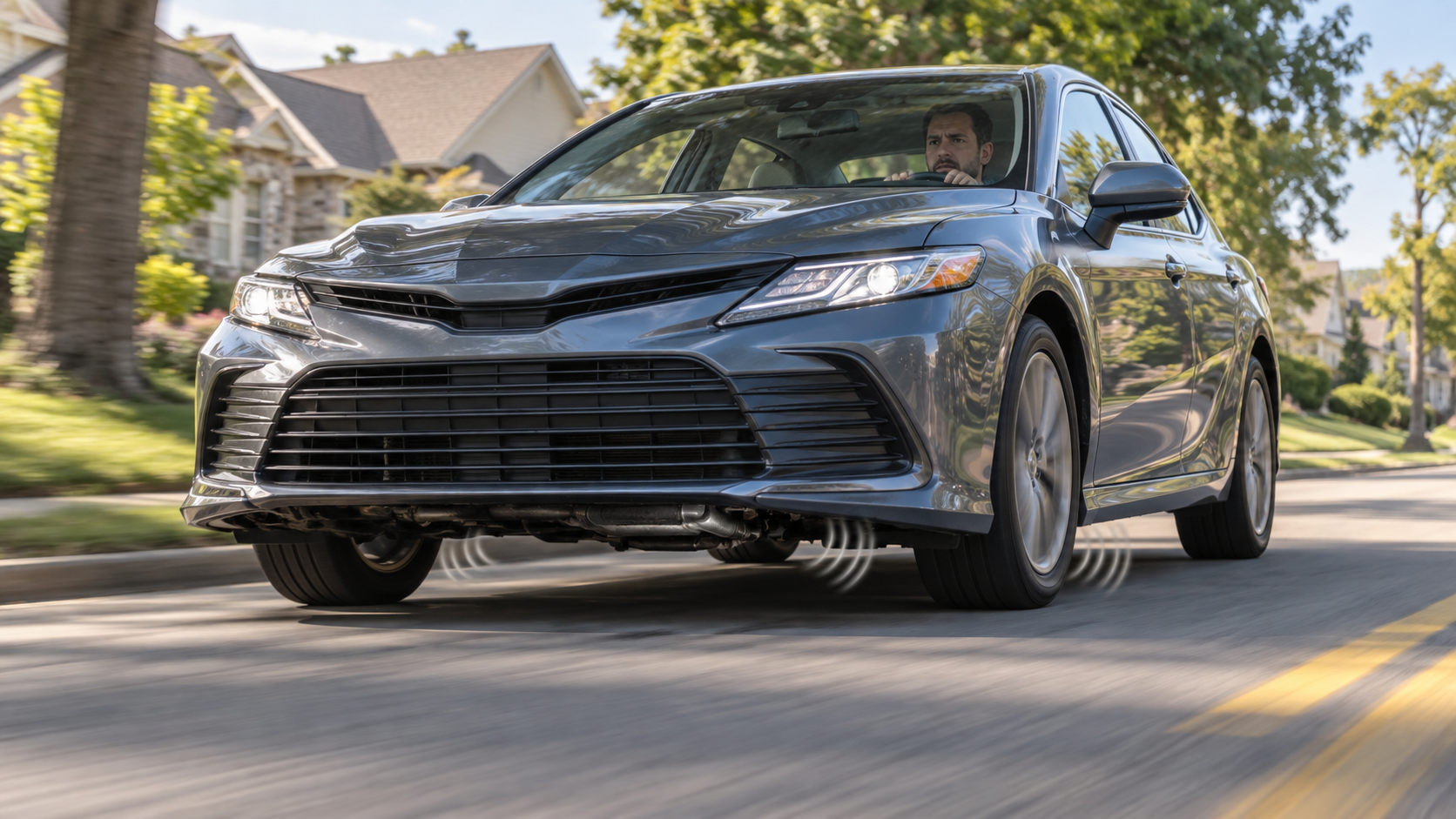
Few car noises are more irritating than a rattle that appears the moment you start driving.
You hear it over one bump. Then again at the next stoplight. Maybe it disappears on smooth pavement and comes back when you accelerate. Pretty soon the radio is off and you’re leaning toward the dashboard trying to figure out whether the noise is inside the cabin, under the hood, or somewhere beneath the car.
A rattling noise when driving can come from something as minor as a loose heat shield or interior trim piece. It can also point to worn suspension parts, exhaust problems, engine issues, loose brake hardware, or components that need attention fairly quickly.
The sound itself rarely gives the entire answer.
What matters more is when the rattle happens, where it seems to come from, and whether anything else changes at the same time.
Does it happen only over bumps? Only when accelerating? At idle too? Does the steering feel different? Is the check-engine light on? Those clues can narrow the search much faster than simply describing the car as “noisy.”
Start With the Pattern, Not the Part
Before assuming the suspension is falling apart, spend a minute noticing the conditions that trigger the sound.
A rattle over rough pavement usually points you in a different direction than a metallic rattle that appears under acceleration. A sound from the dashboard may have nothing to do with the drivetrain. And a rattle that follows engine speed while the vehicle is parked is probably not coming from a wheel bearing.
Useful clues include:
- Whether the noise happens at idle, while moving, or both.
- Whether bumps make it louder.
- Whether the rattle changes with engine RPM.
- Whether it appears during acceleration or only while coasting.
- Whether braking changes the sound.
- Whether turning left or right affects it.
- Whether it seems to come from the front, rear, cabin, or underneath.
- Whether the vehicle recently had exhaust, brake, suspension, or engine work.
Those details matter because “rattle” describes a sound, not a diagnosis.
Common Sources of a Rattling Noise
| Where the Noise Seems to Come From | When It Often Happens | Possible Areas to Inspect |
|---|---|---|
| Under the car | Idle, low speed, bumps, acceleration | Heat shields, exhaust hangers, catalytic converter, loose exhaust parts |
| Front suspension | Bumps, rough roads, turning | Sway-bar links, strut mounts, control-arm bushings, ball joints |
| Wheel area | Bumps, braking, low-speed driving | Brake hardware, wheel fasteners, suspension parts |
| Engine bay | Acceleration, idle, changing RPM | Belt components, mounts, shields, accessories, internal engine concerns |
| Dashboard or doors | Rough roads, vibration | Trim panels, glove box contents, clips, vents, door hardware |
| Rear of vehicle | Bumps, starts and stops | Exhaust, spare tire, cargo, suspension, loose trunk components |
Loose Exhaust Heat Shields Are Surprisingly Common
If the rattle sounds metallic and comes from underneath the car, an exhaust heat shield deserves attention.
Heat shields are thin metal panels installed around hot exhaust components. Their job is simple: keep exhaust heat away from the floor, fuel system, wiring, and nearby materials.
Because they are thin and exposed to years of heat, moisture, road salt, and vibration, their mounting points can corrode or loosen.
Then the shield begins vibrating against the exhaust or body.
The resulting noise can sound far more serious than the actual problem.
A loose shield may rattle at idle, during acceleration, or only within a narrow engine-speed range. Sometimes the sound disappears completely once RPM moves higher.
That “only around 1,500 to 2,000 RPM” type of complaint is a useful clue.
Exhaust Hangers and Loose Exhaust Parts
The exhaust system is suspended beneath the vehicle with brackets, rubber isolators, and hangers.
If one breaks or stretches, part of the exhaust can move farther than it should.
It may tap against the floor, crossmember, suspension, or another exhaust section.
You might hear the rattle when:
The vehicle pulls away from a stop, drives over a bump, shifts between Drive and Reverse, or the engine rocks slightly under acceleration.
Broken internal parts inside a muffler or catalytic converter can also create a metallic rattle.
A catalytic converter with damaged internal material may sound like small stones shaking inside a metal container.
That does not automatically mean the converter itself was the original problem. Engine misfires, oil burning, or excessive fuel entering the exhaust can overheat and damage a converter.
So if a converter has failed internally, finding the reason matters too.
Rattling Over Bumps Often Points Toward Suspension
If the car is quiet on a smooth highway but starts chattering over potholes, patched pavement, or speed bumps, the suspension deserves a closer look.
Modern suspension systems contain multiple joints, bushings, links, mounts, and fasteners. A small amount of looseness in one part can make a surprising amount of noise.
Common suspects include sway-bar links and sway-bar bushings.
These parts help control body roll when the vehicle corners. When the joints develop play, they often create a light clunk or rattle over small sharp bumps.
The funny thing is that the car may still feel fairly normal.
That is why owners sometimes live with the sound for months before having it checked.
Strut Mounts and Shock Hardware
Struts and shocks do more than make the ride comfortable.
They help control wheel movement and keep the tires in contact with the road.
The mounting hardware around them can wear too.
A worn upper strut mount may produce knocking or rattling, especially over uneven pavement or while turning. Loose shock hardware can create similar sounds.
If the car also feels bouncy, unstable, or unusually floaty after bumps, the noise deserves more attention.
A suspension rattle combined with poor handling is more important than an isolated trim noise.
Control-Arm Bushings and Ball Joints
Control arms help locate the wheel and allow the suspension to move through its normal range.
Rubber bushings isolate vibration where these arms attach to the vehicle.
As bushings age, the rubber can crack, soften, separate, or allow excessive movement.
That may create a knock, clunk, or rattle during braking, acceleration, turning, or travel over rough surfaces.
Ball joints can also develop play.
Because ball joints help control wheel movement, severe wear is not something to ignore. A technician can check for looseness using the correct inspection method for that suspension design.
Could the Rattle Be Coming From the Brakes?
Yes.
Brake pads sit inside calipers and normally have clips, shims, springs, or other hardware designed to keep them positioned correctly and control noise.
If hardware is missing, damaged, incorrectly installed, or worn, the pads may move slightly and rattle.
One clue is a noise that changes or disappears when you gently press the brake pedal.
If a rattle is present over bumps but vanishes as soon as the brakes are lightly applied, brake hardware becomes worth inspecting.
Do not automatically assume it is harmless, though.
Loose caliper bolts, damaged components, or other brake faults require prompt attention.
A Loose Wheel Is a Different Situation
A loose wheel or improperly tightened wheel fasteners can produce knocking, rattling, vibration, or movement that feels strange through the steering wheel.
This is not a “I’ll look at it next month” problem.
If the noise started immediately after tire replacement, brake work, wheel removal, or another service that involved taking a wheel off, have the wheel fasteners checked promptly.
Do not keep driving if the vehicle develops severe vibration, wobbling, or obvious wheel movement.
Rattling During Acceleration
This particular pattern can come from several completely different systems.
If the noise appears only when you press the accelerator, think about what changes at that moment.
The engine produces more torque. The exhaust moves slightly. Engine mounts are loaded. RPM rises. Combustion pressure increases.
Any of those changes can expose a loose or worn part.
A heat shield may start resonating. A worn engine mount may let the powertrain shift enough for something to touch the body. A loose exhaust section may vibrate.
There is also another sound drivers sometimes call a rattle: spark knock or detonation.
Engine Knock Can Sound Like Metallic Rattling
Combustion-related pinging or knocking can sound like small metal pieces rattling inside a can, particularly during acceleration or climbing a hill.
This noise should not be confused with a loose heat shield.
Modern engines have knock-control systems designed to help prevent harmful combustion, but problems can still occur.
Fuel quality, overheating, excessive deposits, incorrect engine conditions, sensor faults, or other issues may contribute depending on the vehicle.
If the sound seems to come from the engine itself and appears under load, have it diagnosed rather than repeatedly accelerating hard to “test” it.
Rattling at Idle
A car does not need to be moving to rattle.
If you hear the noise while parked with the engine running, that immediately rules out quite a few wheel and road-related causes.
Listen for whether the sound changes when you gently increase RPM.
If it appears only at a certain speed, resonance from a shield, bracket, exhaust component, or loose cover becomes possible.
Accessory-drive components can also generate rattling sounds.
The serpentine-belt system may include an automatic tensioner, idler pulleys, alternator pulley, air-conditioning compressor, and other rotating components depending on the engine.
Wear in one of those parts can produce noise that follows engine speed.
Timing Components Can Also Rattle
Some engines rely on timing chains, guides, and hydraulic tensioners.
If those parts wear or lose proper tension, a rattling sound may develop.
It may be especially noticeable for a short period during startup, although the exact behavior varies widely by engine design.
Timing-system noises deserve proper diagnosis because those components control the relationship between the crankshaft and camshafts.
A loose interior trim panel is annoying.
A serious timing-system problem is a very different category.
Engine Mounts Can Create Unexpected Noises
Engine and transmission mounts support the powertrain while isolating vibration from the body.
When a mount deteriorates, the engine may move more than intended.
That movement can create thumps or rattles when you accelerate, brake, shift into gear, or move between Drive and Reverse.
Sometimes the failed mount itself does not make the actual rattle.
Instead, the extra engine movement lets an exhaust pipe, bracket, hose, or shield contact another component.
That is why simply locating the sound is not always enough. The part making the noise may not be the part causing the excessive movement.
Rattling From Inside the Cabin
Before scheduling a major suspension repair, empty the cup holders.
Seriously.
Coins, keys, sunglasses, garage-door remotes, water bottles, child-seat hardware, and items in door pockets can create surprisingly convincing automotive noises.
The glove box is another classic source.
So is the trunk.
Check the spare tire and jack if your vehicle carries them. A loose jack handle can make an impressive metallic rattle over every bump.
Interior trim clips also loosen with age. Dashboard panels, door cards, center consoles, speaker covers, and vents can develop vibration-related noises.
If pressing lightly on a panel makes the sound disappear, you may have found the area.
Rattling From the Rear of the Car
A rear rattle can come from suspension, exhaust, brakes, or simply something loose in the cargo area.
Start with the easy stuff.
Remove loose objects from the trunk. Check whether the spare wheel, jack, cargo floor, folding rear seats, and luggage cover are secure.
If the noise remains, suspension components such as shock mounts, sway-bar links, or bushings may need inspection.
An exhaust pipe or muffler near the rear bumper can also contact the body if a hanger fails.
When the Noise Happens Can Narrow It Down
| When You Hear the Rattle | Possible Sources | Other Clues to Notice |
|---|---|---|
| Only over bumps | Suspension, brake hardware, exhaust, loose cargo | Does light braking change it? |
| During acceleration | Heat shield, exhaust, mount, engine-related noise | Does it follow RPM or vehicle speed? |
| At idle | Heat shield, belt-drive part, engine mount, exhaust | Does a small RPM change stop it? |
| While turning | Suspension, steering, loose wheel-area component | Only one direction or both? |
| During braking | Brake hardware, suspension movement | Any vibration or change in pedal feel? |
| At highway speed | Aero panels, shields, underbody covers, wheel-related issues | Does speed affect frequency? |
| After recent repair | Loose fastener, shield, trim, bracket | What parts were removed? |
Could an Underbody Panel Be Loose?
Modern cars often have plastic aerodynamic panels underneath the engine and floor.
They help manage airflow, improve fuel efficiency, and protect certain components from road debris.
Those panels are commonly held in place with screws, clips, and small fasteners.
Hit a curb, drive through deep snow, or lose a clip during an oil change and a corner can begin hanging down.
At low speed, you may hear a light tapping or rattling.
At highway speed, airflow can make the panel flap violently.
If the noise started after an oil change or underbody service, checking the splash shield is a sensible first step.
What About Loose Hood or Body Hardware?
Not every exterior rattle is mechanical.
A hood latch that needs adjustment, loose license plate, worn rubber hood stop, damaged wheel-well liner, or loose bumper trim can make noise as the body flexes.
A license plate touching the bumper can be especially annoying because it may buzz at very specific engine speeds.
It sounds mechanical.
It is sometimes literally two screws and a piece of plastic.
Can a Bad Wheel Bearing Rattle?
Wheel bearings are more often associated with humming, growling, or grinding that changes with road speed.
A severely worn wheel bearing can eventually create additional noise and looseness, but a light metallic rattle over bumps is not the classic presentation.
If the sound becomes a steady growl that gets louder with speed and may change as the vehicle turns, a wheel-bearing inspection makes more sense.
Again, sound descriptions overlap.
The driving pattern helps.
Could the CV Axle Be Making the Noise?
Constant-velocity joints are better known for clicking while turning, especially when an outer CV joint is worn.
Inner joints may contribute to vibration during acceleration.
Drivers sometimes describe either noise as rattling.
If you hear rhythmic clicking when making tight turns under power, a CV joint deserves inspection.
Look for damaged CV boots too. A torn boot can release grease and allow dirt and moisture into the joint.
What You Can Check Before Visiting a Shop
You do not need to crawl under an unsupported vehicle or start disassembling suspension parts.
Basic observation is already useful.
- Empty the glove box, door pockets, cup holders, and trunk.
- Check that the spare tire and jack are secure.
- Look for a loose license plate or obvious exterior trim.
- Listen with the car parked to see whether the noise also happens at idle.
- Notice whether engine RPM or road speed affects the frequency.
- See whether light braking changes a bump-related rattle.
- Think about whether the sound appeared after recent service.
- Look for hanging plastic panels without crawling beneath the vehicle.
- Pay attention to warning lights or changes in steering, braking, or handling.
That is plenty of useful information for a technician.
Do Not Crawl Under a Car Supported Only by a Jack
This deserves its own section.
A vehicle jack is intended to raise a vehicle, not necessarily to keep you safe underneath it while you inspect exhaust or suspension components.
Never place yourself under a vehicle that is supported only by a basic emergency jack.
Proper lifting points, suitable jack stands, a level surface, and correct procedures are necessary for underbody work.
If you do not have the right equipment, let a repair shop put the car on a lift.
A five-minute inspection is not worth risking serious injury.
Can You Keep Driving With a Rattling Noise?
Sometimes yes. Sometimes absolutely not.
A loose dashboard panel is not likely to strand you.
A loose wheel, failing ball joint, severe engine knock, damaged brake component, or major suspension fault can create a real safety problem.
The difficulty is that you may not know which one you have yet.
A light rattle that has been unchanged for months and clearly comes from interior trim is different from a new metallic knock accompanied by steering vibration.
Use the other symptoms as your guide.
When You Should Stop Driving
Pull over safely and arrange inspection rather than continuing to drive if the rattle is accompanied by:
- Severe steering-wheel vibration or vehicle wobbling.
- A wheel that appears loose or out of position.
- Sudden changes in steering response.
- Reduced braking performance or an abnormal brake pedal.
- A flashing check-engine light with strong engine shaking.
- Low oil-pressure or overheating warnings.
- Grinding or heavy metallic banging from the engine.
- A component visibly dragging beneath the vehicle.
- Smoke, burning smells, or signs of overheating.
A new noise plus a change in how the car drives deserves more urgency than a noise alone.
What if the Rattle Starts Right After a Repair?
Call the shop that performed the work.
A new noise immediately after service does not automatically mean someone made a mistake, but the timing matters.
Perhaps an underbody panel was removed for an oil change and a clip did not seat correctly. Maybe exhaust work changed the position of a heat shield. Brake service may have disturbed hardware.
Tell the shop exactly when the noise began.
That can save a lot of diagnostic time.
Why Recording the Noise Can Help
Car noises have an annoying habit of disappearing the moment you arrive at the repair shop.
If you can safely record the sound with your phone while someone else drives, that recording may help.
Do not hold a phone and drive around trying to capture the perfect rattle.
Instead, let a passenger record it.
Also tell the technician the road conditions and speed where the sound appears.
“It rattles” is useful.
“It rattles from the right front between 20 and 30 mph over small sharp bumps, and disappears when I lightly press the brakes” is much better.
How a Mechanic Tracks Down a Rattle
The process usually begins with a road test.
A technician wants to reproduce the noise under the same conditions you described.
Then the vehicle can be inspected on a lift.
Suspension joints and bushings may be checked for excessive play. Exhaust hangers and heat shields can be moved by hand. Brake hardware can be inspected. Underbody panels, engine mounts, wheel fasteners, and other likely sources can be examined.
If the sound follows engine speed while the car is stationary, the search moves toward the engine bay and exhaust system.
If it follows vehicle speed instead, wheel, brake, driveline, or road-related components become more relevant.
There is no magic scanner that identifies every mechanical noise.
A good diagnosis often comes down to reproducing the symptom and methodically checking what can physically move.
Why You Should Avoid Replacing Parts Based on Sound Alone
Mechanical noises travel through metal.
A rattle that sounds like it comes from the passenger-side dashboard may actually originate several feet away.
Engine vibrations can travel into exhaust brackets. Suspension impacts can resonate through the body. A loose heat shield can sound like an internal engine problem.
This is why replacing a part just because an internet video “sounds exactly the same” can get expensive quickly.
Two cars can make almost identical noises for completely different reasons.
The sound helps narrow the possibilities.
Inspection confirms them.
FAQ
Why does my car rattle when I drive over bumps?
Common possibilities include worn sway-bar links, suspension bushings, strut or shock mounts, loose brake hardware, exhaust components, or something unsecured inside the vehicle. The suspension is more suspicious if the noise appears mainly on rough pavement.
Why do I hear a metallic rattle when accelerating?
A loose exhaust heat shield, exhaust component, worn engine mount, or another part that moves under engine torque can create a metallic rattle. Combustion-related engine knock can also sound metallic and should be diagnosed if it appears under load.
Can a loose heat shield cause a loud rattle?
Yes. Thin exhaust heat shields can make surprisingly loud metallic noises when their mounting points corrode or loosen. The sound may occur only at certain engine speeds.
Why does my car rattle at idle but stop when I accelerate?
A component may be resonating specifically at idle speed. Exhaust shields, brackets, belt-drive components, engine mounts, and loose covers are possible areas to inspect.
Can worn suspension parts make a rattling noise?
Yes. Sway-bar links, bushings, ball joints, strut mounts, and other suspension parts can produce rattling or clunking over bumps when they develop excessive movement.
Is it safe to drive a car that is rattling?
It depends on the cause. Interior trim or a loose heat shield may not be immediately dangerous, while loose wheel hardware, brake faults, serious suspension wear, or engine problems can be unsafe. Changes in steering, braking, or handling require prompt attention.
Why did my car start rattling after an oil change?
An underbody splash shield or heat shield may have been moved during service and not fully secured afterward. That is not the only possibility, but if the sound began immediately after service, mention the timing to the shop.
Conclusion
A rattling noise when driving can be anything from a loose coin in the cup holder to a suspension or engine problem that should not be ignored.
The sound alone rarely tells the whole story.
Pay attention to when it happens.
Over bumps? Think suspension, brakes, exhaust, or loose cargo.
During acceleration? Think about exhaust movement, mounts, engine load, and combustion-related noises.
At idle too? The wheels are probably not your first suspect. Heat shields, belt-drive parts, exhaust components, and engine-related sources move higher on the list.
And if pressing the brake pedal changes the sound, tell the technician. That small clue can save time.
Start with the easy things before assuming the worst.
Empty the glove box. Secure the spare tire. Look at the license plate. Check whether a plastic splash panel is hanging down. Think about recent repairs.
Cars contain thousands of parts, and not every scary sound comes with a scary repair bill.
But do not let that turn into the opposite mistake.
If the rattle arrives with steering vibration, braking changes, severe engine shaking, overheating, low oil pressure, visible wheel movement, or something dragging under the car, stop treating it like background noise.
Those combinations deserve prompt attention.
The location matters too, but remember that sound travels through the body of a vehicle. What seems like a dashboard rattle can begin underneath the floor. What sounds like an engine rattle might actually be an exhaust heat shield vibrating against a bracket.
That is why a hands-on inspection beats guessing from sound clips.
If you visit a repair shop, give them details rather than simply saying the car rattles.
Tell them the speed, road surface, engine temperature, whether you were accelerating or braking, and which side of the car seems louder.
Even better, describe whether the noise changes when the engine RPM changes.
Those clues help separate engine-speed noises from road-speed noises.
And one final thought: noises tend to get our attention before mechanical failures become obvious in other ways.
That can be useful.
A rattle is sometimes your car’s early warning that a bracket is loose, a bushing is developing play, a heat shield has started corroding, or a suspension joint needs attention.
Finding the cause early is usually easier than waiting until the noise becomes a clunk, vibration, warning light, or breakdown.
So listen to the pattern, check the obvious stuff, and investigate anything new that does not go away.
Your car does not need to be perfectly silent.
But a new rattle is still worth asking about.


Leave a Reply