



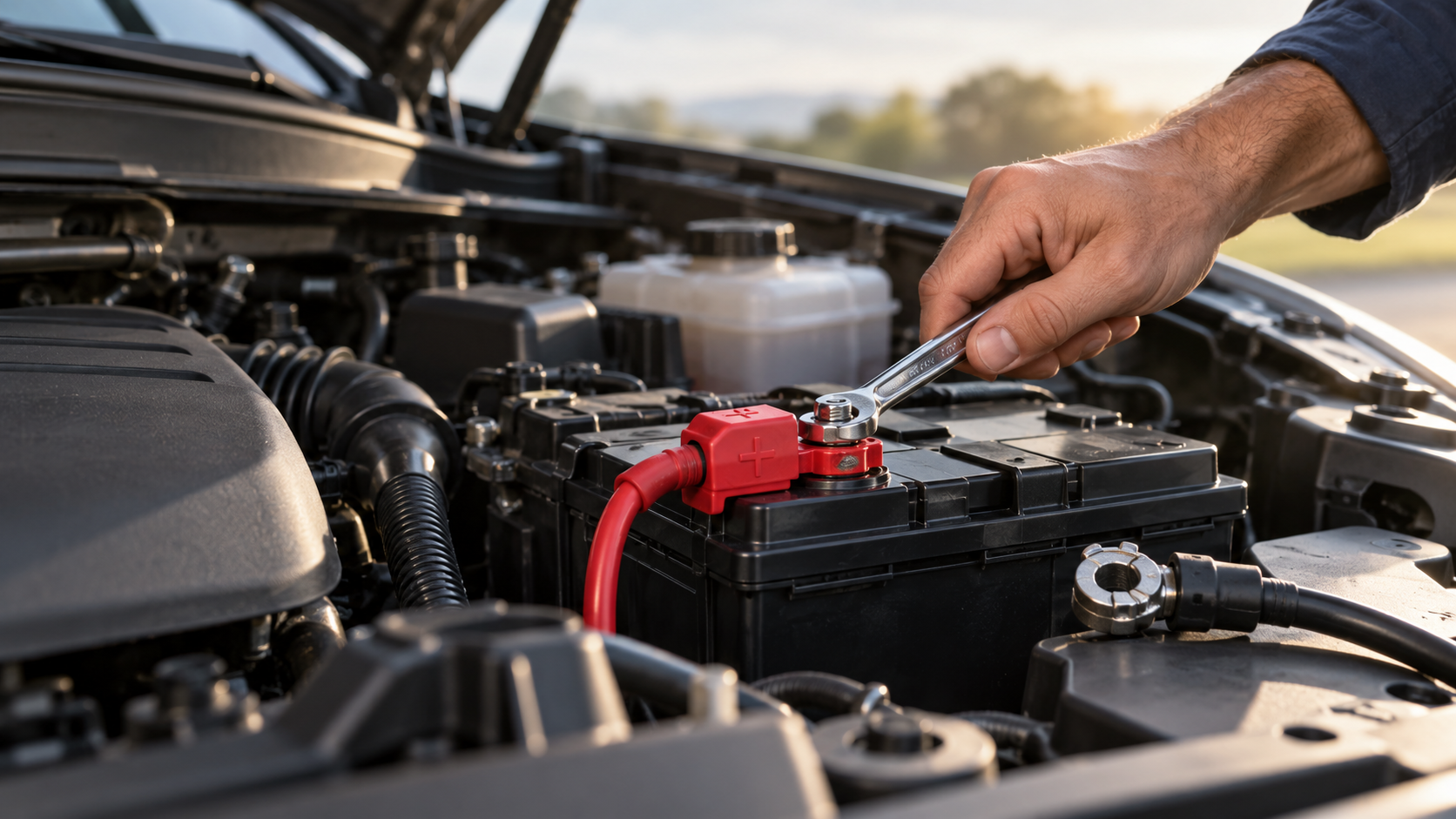
You have a car battery sitting in the engine bay, both cables disconnected, and now comes the surprisingly common question: which terminal goes on first?
For a typical 12-volt car battery, connect the positive terminal first and the negative terminal last.
When disconnecting the battery, reverse the order: negative first, then positive.
It sounds like one of those tiny details that shouldn’t matter much. It does.
The order reduces the chance of accidentally creating a short circuit between the battery’s positive terminal and the metal body of the vehicle while you’re working with a wrench.
And considering how much current an automotive battery can deliver, avoiding that little spark-show is a very good idea.
There is an important catch, though. Reconnecting a battery is not exactly the same procedure as jump-starting a dead vehicle. Hybrids, EVs, cars with battery-monitoring systems, and vehicles with remote battery locations may also have manufacturer-specific instructions.
So the short answer is simple. The complete answer needs a little context.
The Simple Rule to Remember
When installing or reconnecting a conventional automotive battery:
- Connect the positive cable to the positive battery terminal first.
- Secure the positive connection.
- Connect the negative cable to the negative terminal last.
- When disconnecting the battery, remove the negative cable first.
- Remove the positive cable second.
A handy memory trick is this: negative comes off first and goes on last.
That’s easier to remember than trying to memorize two separate procedures.
Why Does the Connection Order Matter?
The negative terminal of a conventional vehicle battery is normally connected to the vehicle’s chassis and engine through the ground system.
That means much of the metal around you under the hood is electrically connected to the negative side of the battery.
Now imagine both battery terminals are already connected.
You put a wrench on the positive terminal and accidentally touch the wrench against a metal bracket, body panel, or engine component.
You have just created a direct electrical path between positive and ground.
The result can be a large spark, an extremely hot tool, damaged electrical components, or potentially a battery-related hazard.
But if the negative battery cable has not yet been connected, the vehicle’s chassis does not complete that same circuit through the battery.
That is why the positive cable is normally installed first.
Why Disconnect the Negative Terminal First?
The same logic works backward when removing a battery.
If you disconnect the negative terminal first, you break the battery’s electrical connection to the vehicle chassis.
After that, accidentally touching the body with a wrench while loosening the positive terminal is much less likely to create a direct battery short through the chassis.
Remove the positive terminal first while the negative cable is still attached, however, and the surrounding metal remains connected to battery negative.
A wrench touching both positive and metal ground can complete the circuit.
This is why technicians generally follow the same familiar sequence: negative off first, positive off second; positive on first, negative on last.
Battery Connection Order at a Glance
| Task | First Step | Second Step |
|---|---|---|
| Disconnecting a battery | Remove negative (-) | Remove positive (+) |
| Connecting a battery | Attach positive (+) | Attach negative (-) |
| Removing an old battery | Negative cable off | Positive cable off, then remove battery |
| Installing a replacement battery | Positive cable on | Negative cable on last |
How to Identify Positive and Negative Battery Terminals
Do not rely purely on cable color.
Red usually means positive and black usually means negative, but vehicles get repaired, cables get replaced, protective covers disappear, and aftermarket wiring can make things less obvious.
Look at the actual battery markings.
The positive terminal should be marked with a plus sign (+). The negative terminal should be marked with a minus sign (-).
The positive terminal may also have a red plastic cover.
In many vehicles, the negative cable can be traced to a grounding point on the body or engine.
If the markings are dirty, clean enough of the battery surface to read them before connecting anything.
Guessing polarity is not worth it.
What Happens If You Connect the Negative Terminal First?
If you simply connect the negative terminal first and then carefully connect the positive cable without touching anything else, the vehicle may still work normally.
The battery does not instantly fail because the order was reversed.
The problem is the extra risk created while attaching the positive cable.
With the negative cable already connected, the body and engine are tied to the negative side of the battery. If your wrench slips from the positive terminal onto grounded metal, you may create a short circuit.
So the recommended order is mainly about making the job safer.
It is one of those habits that costs nothing and reduces unnecessary risk.
What Happens If You Connect the Battery Backward?
This is a much bigger problem.
Connecting positive to negative and negative to positive is called reverse polarity.
Depending on the vehicle, reverse polarity may blow fuses, damage fusible links, harm control modules, damage charging-system components, or create sparks immediately.
Modern cars contain a large amount of sensitive electronics, so this is not the place to experiment.
If you notice that a cable seems strangely difficult to position on the terminal it is supposed to reach, stop.
Recheck the battery orientation and terminal markings.
Replacement batteries can have different terminal layouts even when their cases appear similar.
Connecting a Battery Step by Step
First, make sure the vehicle is off. Remove the key if the car uses a traditional ignition, and keep the key fob away from the vehicle if practical.
Modern cars can wake electronic systems when a door opens or when the key is nearby, so giving the car a moment to settle before reconnecting the battery is sensible.
Place the battery securely in its tray and install the battery hold-down correctly. The battery should not be free to move around while the vehicle is driven.
Then confirm the polarity markings.
Attach the positive cable to the positive terminal. Seat the clamp correctly and tighten it according to the vehicle or battery-terminal design. The clamp should be secure, but overtightening can damage battery posts or cable ends.
Once the positive connection is secure, attach the negative cable.
You may see a small spark when the final connection is made because some vehicle electronics immediately draw a small amount of power. A tiny brief spark can occur on some vehicles.
A large, violent, continuous spark is different. If something seems wrong, stop rather than forcing the connection.
What Should You Check Before Reconnecting a Battery?
A replacement battery should match the vehicle’s requirements. Physical size matters, but so do terminal orientation, battery type, cold-cranking capability, and any specifications required by the manufacturer.
Before installing it, check a few basics:
- Make sure the ignition and electrical accessories are off.
- Confirm the battery is the correct type and orientation.
- Inspect battery cables for corrosion, cracks, or damaged terminals.
- Make sure the positive and negative markings are clearly identified.
- Check that the battery tray and hold-down are secure.
- Keep metal tools from bridging the two battery terminals.
- Remove metal jewelry such as rings or bracelets before working around the battery.
- Follow the owner’s manual if the vehicle has special battery procedures.
Why the Battery Hold-Down Matters
This part gets overlooked because it does not seem electrical.
But the battery needs to be physically secured.
A battery that slides around can stress its cables, damage its case, or contact nearby components. Vibration is not exactly great for battery life either.
If you removed a bracket, clamp, crossbar, or lower hold-down during battery replacement, reinstall it correctly.
The battery should sit firmly in its intended location.
Should the Terminals Be Extremely Tight?
No.
They need to be secure, not crushed.
A properly installed terminal clamp should not easily rotate around the battery post by hand.
But excessive tightening can damage the clamp, strip hardware, or harm the battery terminal itself.
If a terminal remains loose even after normal tightening, the problem may be a stretched or damaged cable end rather than a need for more force.
Replacing a damaged terminal is better than trying to turn the nut until something gives up.
Corrosion Can Cause Starting Problems
You reconnect the battery correctly, turn the key, and get slow cranking or clicking.
The battery may not be the problem.
Corrosion between the battery post and terminal clamp can create electrical resistance. So can a loose connection.
The starter motor needs a large amount of current. Even a connection that seems good enough to power dashboard lights may struggle when the starter demands much more current.
White, blue, or greenish deposits around the terminals are worth dealing with.
Follow safe cleaning procedures and avoid allowing cleaning residue to enter the battery.
Do Modern Cars Need Battery Registration?
Some do.
Many newer vehicles have battery-management or energy-management systems that monitor battery state, charging behavior, age, or battery type.
After installing a replacement battery, certain vehicles require the new battery to be registered, initialized, or coded through the vehicle’s diagnostic system.
The exact process varies by manufacturer and model.
On those vehicles, physically connecting the battery is only part of the job.
If the manufacturer calls for battery registration and it is skipped, charging strategy may not operate as intended.
This is especially relevant on vehicles with start-stop systems and advanced energy-management features.
What About AGM and EFB Batteries?
Modern start-stop vehicles often use AGM or EFB battery technology rather than a conventional flooded lead-acid battery.
An AGM battery should not automatically be replaced with whatever inexpensive battery happens to fit the tray.
Battery type can be part of the vehicle’s charging strategy.
If you are replacing a battery, match the required technology and specification listed for the vehicle.
Again, the cable order remains familiar in a conventional negative-ground system: positive first, negative last.
But the replacement battery itself still needs to be correct.
Why Did My Car Act Weird After Reconnecting the Battery?
Disconnecting battery power can reset certain electronic memories.
After reconnection, you may notice that the clock is wrong, radio presets are gone, automatic windows need initialization, idle behavior is temporarily different, or various warning indicators appear briefly.
Some vehicles relearn settings automatically after a short drive.
Others require a specific initialization procedure.
The steering-angle system, power windows, sunroof, electronic throttle, transmission adaptations, or other systems may have their own procedures depending on the car.
This is one reason checking the owner’s manual before battery replacement is a smart move on newer vehicles.
Can Disconnecting a Battery Erase Important Data?
It can erase some stored settings.
The extent varies enormously between vehicles.
Older cars may lose little more than the radio clock. Newer vehicles can have numerous control modules storing learned values and user preferences.
Diagnostic trouble codes and readiness information can also be affected depending on the system and circumstances.
If a vehicle is being diagnosed for an emissions or drivability problem, disconnecting the battery before diagnostic scanning can remove information that would have helped identify the issue.
So do not automatically disconnect a battery simply because a warning light appears.
Reconnecting a Battery Is Not the Same as Jump-Starting
This distinction matters.
When people search for when connecting a battery which terminal first, they sometimes actually mean jumper cables.
A jump-start uses two batteries or a portable jump pack, and the recommended connection sequence is different from simply reinstalling your car’s battery.
Many vehicle manufacturers instruct drivers to make the final negative jumper connection to a designated chassis or engine ground point away from the discharged battery rather than directly to its negative battery post.
This helps keep possible sparking away from the battery.
Because battery locations, jump terminals, hybrids, and electronic systems vary, use the jump-start procedure in the owner’s manual for the specific vehicle.
Battery Reconnection vs. Jump-Starting
| Situation | Typical Approach | Important Note |
|---|---|---|
| Reinstalling a normal 12V battery | Positive first, negative last | Confirm correct polarity before connecting |
| Disconnecting a normal battery | Negative first, positive last | This reduces accidental short-circuit risk |
| Using jumper cables | Follow vehicle-specific jump sequence | Final connection may be made to a ground point |
| Using a jump pack | Follow jump-pack and vehicle instructions | Connection sequence can vary by equipment |
| Hybrid vehicle | Use manufacturer’s designated 12V procedure | Do not treat high-voltage components like a normal battery |
| Electric vehicle | Follow manufacturer instructions | Low-voltage and high-voltage systems are separate concerns |
What About Hybrid Cars?
Hybrid vehicles normally have a low-voltage electrical system in addition to their high-voltage traction battery.
The low-voltage battery may be 12 volts, but the overall vehicle is not something to approach like an old pickup truck from the 1990s.
High-voltage cables and components require specialized procedures and training.
If you are working only with the conventional low-voltage battery, follow the manufacturer’s instructions for that specific model.
Do not touch high-voltage components simply because the 12-volt battery has been disconnected.
Disconnecting the low-voltage battery does not mean every high-voltage part of a hybrid or EV is automatically safe to service.
What If the Battery Is in the Trunk?
That’s normal on many vehicles.
Manufacturers place batteries in trunks, under rear seats, and in other locations for packaging or weight-distribution reasons.
Some of these vehicles provide dedicated positive and negative jump points under the hood.
Those jump points are intended for jump-starting or charging according to manufacturer instructions; they do not necessarily mean the battery itself is located there.
If replacing the battery, you still need to access and correctly connect the actual battery cables.
Is a Small Spark When Connecting the Negative Terminal Normal?
A very small brief spark can happen when the final connection is made.
Modern vehicles may immediately power security systems, computers, interior modules, keyless-entry receivers, and other electronics.
That initial current draw can cause a tiny spark.
But there is an important difference between a tiny momentary spark and a strong repeated arc.
If the cable produces aggressive sparking or becomes hot, do not keep forcing it onto the terminal.
Recheck polarity and make sure there is not an electrical fault or major load switched on.
Can You Touch a Car Battery Terminal?
A standard 12-volt automotive battery generally does not present the same electric-shock hazard through intact dry skin as household mains electricity.
But that absolutely does not make the battery harmless.
The danger is its ability to deliver very high current through a low-resistance path.
A metal ring, watch band, wrench, or bracelet bridging positive and ground can become extremely hot very quickly.
Lead-acid batteries also contain corrosive electrolyte, and batteries can release flammable hydrogen gas under certain conditions.
Treat them with respect.
Do Not Connect a Damaged Battery
A battery that is cracked, leaking, visibly swollen, or frozen should not simply be reconnected and “tested.”
Damage to the case can indicate a serious problem.
A strong sulfur or rotten-egg smell is also a reason to stop and investigate rather than continuing to connect or charge the battery.
Keep flames, cigarettes, and spark-producing tools away from batteries.
Common Battery-Connection Mistakes
The actual job is simple, but a few errors show up again and again:
- Connecting the negative terminal first during installation.
- Removing the positive terminal first while the negative is still connected.
- Assuming cable color instead of checking battery polarity markings.
- Installing a battery with the terminals in the wrong orientation.
- Leaving terminal clamps loose.
- Overtightening clamps and damaging the terminal.
- Forgetting the battery hold-down.
- Using an incorrect battery technology on a start-stop vehicle.
- Ignoring battery registration when the vehicle requires it.
- Treating a hybrid or EV battery system like a conventional gas-powered car.
What If the Car Will Not Start After Battery Replacement?
Start with the simple stuff.
Make sure the terminals are fully seated and secure. Confirm polarity. Check that protective caps or shipping covers were removed where appropriate.
If the dashboard remains completely dead, inspect the main battery connections.
If lights come on but the starter clicks rapidly, the battery may be discharged or the connection may have excessive resistance.
If you accidentally connected the battery backward, even briefly, stop and have the electrical system checked rather than repeatedly trying to start the vehicle.
A main fuse or fusible link may have opened to protect the system.
What If the Battery Keeps Dying?
Connecting the replacement correctly will not solve a separate charging or electrical problem.
If a battery repeatedly becomes discharged, look beyond the battery itself.
The charging system may not be replenishing it properly. A light or accessory may be staying on. An electronic module may not be going to sleep. A cable connection may be poor.
And sometimes the vehicle simply has an aging battery that can no longer hold enough charge.
Testing is cheaper than replacing battery after battery.
When Should You Let a Professional Handle It?
Battery replacement is straightforward on some vehicles and surprisingly involved on others.
If the battery is buried beneath trim, electronic modules, seats, or other components, professional installation may save a lot of frustration.
The same applies if the vehicle requires registration or coding after replacement.
Get professional help if you find damaged cables, melted terminals, heavy corrosion, unusual sparking, electrical burning smells, or signs the battery has leaked.
And on hybrid or electric vehicles, do not move beyond the manufacturer-approved low-voltage battery procedure unless you have the proper training.
FAQ
When connecting a car battery, which terminal goes first?
For a typical negative-ground 12-volt vehicle, connect the positive terminal first and the negative terminal last. Check the owner’s manual if the vehicle has a special procedure.
Which battery terminal should I disconnect first?
Disconnect the negative terminal first. Then remove the positive terminal. This breaks the battery’s connection to the vehicle chassis before you work around the positive terminal.
What happens if I connect negative first?
The vehicle may still operate, but attaching the positive cable afterward creates more risk of an accidental short if your tool touches grounded metal. Positive first is the safer normal installation order.
Is it normal to see a spark when connecting a battery?
A tiny brief spark can occur as vehicle electronics power up. Heavy, continuous, or aggressive sparking is not something to ignore. Stop and recheck the connection and polarity.
Is battery connection order different for jump-starting?
Yes. Jump-start procedures often use a designated ground point for the final connection. Follow the owner’s manual for the vehicle rather than applying the battery-installation sequence to jumper cables.
Can connecting a battery backward damage a car?
Yes. Reverse polarity can blow fuses or fusible links and may damage charging-system components or electronic modules. Always identify positive and negative markings before connecting the cables.
Do I need to reset anything after replacing my battery?
Possibly. Some vehicles automatically relearn settings, while others may require window, steering, idle, or other initialization. Certain modern vehicles also require battery registration or coding after replacement.
Conclusion
So, when connecting a battery which terminal first?
Positive first.
Negative last.
And when removing the battery, reverse it: negative first, positive second.
There is nothing mysterious about the rule. It is about reducing the chance of accidentally connecting the battery’s positive side directly to the grounded metal of the vehicle through a wrench or another tool.
Once the negative cable has been disconnected, the chassis is no longer connected to the battery in the same way. That makes working around the positive terminal safer.
But correct connection order is only part of the job.
Check the actual plus and minus markings rather than assuming that every red cable is exactly where you expect it to be. Secure the battery properly. Make sure the terminals are clean and tight without overtightening them. Keep tools and jewelry away from situations where they could bridge a terminal and metal ground.
And pay attention to the car you’re working on.
A basic older vehicle may need nothing more after battery replacement than the clock being reset.
A newer vehicle can have battery-monitoring electronics, start-stop technology, AGM batteries, registration procedures, learned settings, and multiple control modules that react when power is removed.
That does not mean you should be afraid of touching the battery.
It simply means the owner’s manual matters more than it did years ago.
The distinction between reconnecting a battery and jump-starting one matters too.
For normal battery installation, positive first and negative last is the familiar rule.
For jumper cables, use the vehicle manufacturer’s sequence. The last connection is often made to a designated engine or chassis ground away from the discharged battery.
And hybrids and EVs deserve another level of care. Their low-voltage systems may look familiar, but high-voltage systems are a completely different matter.
If the battery is damaged, swollen, cracked, leaking, frozen, or producing an unusual odor, do not keep experimenting with connections.
The same goes for heavy sparking or cables that become hot.
Those are signs to stop.
For a healthy conventional battery, though, the rule is refreshingly easy to remember.
Negative comes off first and goes on last.
Keep that one line in your head and you already know the correct order in both directions.


Leave a Reply